
 Featured series
Tag: Wyss Institute for Biologically Inspired Engineering
-
Science & Tech
New facilities for Wyss Institute
Harvard’s Wyss Institute for Biologically Inspired Engineering officially opens new, expansive facilities in Boston and Cambridge to host its fast-growing enterprise.
-
Science & Tech
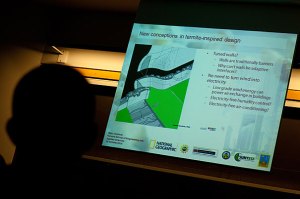
Termites as architects
The air exchange system inside termite mounds provides a natural example of how to harness intermittent winds.
-
Science & Tech
Cracking flight’s mysteries
Harvard engineers have created a millionth-scale automobile differential to guide tiny aerial robots.
-
Campus & Community
SEAS student awarded fellowship
Emily Gardel, a Ph.D. candidate in applied physics at the Harvard School of Engineering and Applied Sciences (SEAS), has been awarded a three-year Department of Energy Office of Science Graduate Fellowship.
-
Science & Tech
Shape-shifting sheets automatically fold into multiple shapes
“More than meets the eye” may soon become more than just for the Transformer line of popular robotic toys. Researchers at Harvard and MIT have reshaped the landscape of programmable matter by devising self-folding sheets that rely on the ancient art of origami. Click here to watch a video of the folding process. Using the…
-
Science & Tech
Living, breathing human lung-on-a-chip
Researchers at Harvard’s Wyss Institute for Biologically Inspired Engineering have created a device that mimics a living, breathing human lung on a microchip. The device, about the size of a rubber eraser, acts much like a lung in a human body and is made using human lung and blood vessel cells.
-
Science & Tech
Replicating nature’s design principles
In nature, cells and tissues assemble and organize themselves within a matrix of protein fibers that ultimately determines their structure and function, such as the elasticity of skin and the contractility of heart tissue. These natural design principles have now been successfully replicated in the lab by bioengineers at Harvard’s Wyss Institute for Biologically Inspired…
-
Science & Tech
Scientists discover how ocean bacterium turns carbon into fuel
Reduce. Reuse. Recycle. We hear this mantra time and again. When it comes to carbon—the “Most Wanted” element in terms of climate change—nature has got reuse and recycle covered. However, it’s up to us to reduce.
-
Science & Tech
Accelerator Fund boon to research
The Harvard Office of Technology Development’s Accelerator Fund helps researchers advance their work to the point where it’s attractive to private industry.
-
Science & Tech
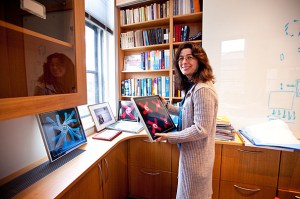
Nature’s fine designs
Nature and its bottom-up processes for creating robust and responsive materials are inspiring new generations of synthetic materials and creative design.
-
Health
Cancer vaccine success
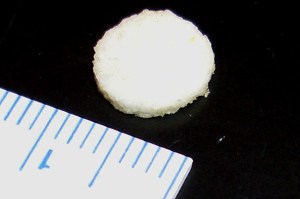
A cancer vaccine carried into the body on a carefully engineered, fingernail-sized implant is the first to successfully eliminate tumors in mammals, scientists report this week (Nov. 25) in the journal Science Translational Medicine.
-
Health
First cancer vaccine to eliminate tumors in mice
A cancer vaccine carried into the body on a carefully engineered, fingernail-sized implant is the first to successfully eliminate tumors in mammals, a team of Harvard bioengineers and biologists report today in the journal Science Translational Medicine. The new approach uses plastic disks impregnated with tumor-specific antigens and implanted under the skin to reprogram the…
-
Science & Tech
Bringing new meaning to the term scientific paper
An insight from the labs of Harvard chemist George M. Whitesides and cell biologist Donald Ingber is likely to make a fundamental shift in how biologists grow and study cells – and it’s as cheap and easy as reaching for a paper towel. Ratmir Derda, a postdoctoral student co-mentored by Whitesides and Ingber at Harvard’s…
-
Health
From stem cells to functioning strip of heart muscle
A team of Harvard Stem Cell Institute (HSCI) scientists at Massachusetts General Hospital (MGH) and collaborators at Harvard’s School of Engineering and Applied Sciences (SEAS) has taken a giant step toward the possibility of using human stem cells to repair damaged hearts. http://www.kaltura.com/p/616782/sp/61678200/embedIframeJs/uiconf_id/5415041/partner_id/616782 The researchers led by HSCI Principal Faculty member Kenneth Chien, M.D., PhD, report using…
-
Science & Tech
Donald Ingber awarded the 2009 BMES Pritzker Distinguished Lectureship for outstanding achievements, originality and leadership
Donald Ingber, M.D., Ph.D., founding director of the Wyss Institute for Biologically Inspired Engineering at Harvard University, has been awarded the Biomedical Engineering Society’s prestigious Pritzker Distinguished Lectureship for 2009. The lectureship recognizes outstanding achievements, a high level of originality and leadership in the science and practice of biomedical engineering. Presentation of the award, a…
-
Campus & Community
Mahadevan, Huybers named MacArthur Fellows
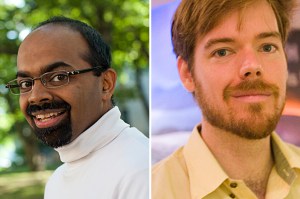
Assistant Professor of Earth and Planetary Sciences Peter Huybers and England de Valpine Professor of Applied Mathematics Lakshminarayanan Mahadevan are named MacArthur Foundation Fellows.
-
Science & Tech
Huybers and Mahadevan named MacArthur Foundation Fellows
Two Harvard faculty members who study present and past ice sheets and the science behind familiar objects and everyday events have been named recipients of prestigious MacArthur Foundation “genius” grants. This year’s awards, announced today by the John D. and Catherine T. MacArthur Foundation, go to Assistant Professor of Earth and Planetary Sciences Peter Huybers…
-
Science & Tech
Research team at Harvard to develop small-scale mobile robotic devices
A multidisciplinary team of computer scientists, engineers, and biologists at Harvard received a $10 million National Science Foundation (NSF) Expeditions in Computing grant to fund the development of small-scale mobile robotic devices. Inspired by the biology of a bee and the insect’s hive behavior, the researchers aim to push advances in miniature robotics and the design of compact…
-
Health
Computer scientists model cell division
Computer scientists at Harvard have developed a framework for studying the arrangement of tissue networks created by cell division across a diverse set of organisms, including fruit flies, tadpoles, and plants. The finding, published in the June 2009 issue of PLoS Computational Biology, could lead to insights about how multicellular systems achieve (or fail to…
-
Science & Tech
Science, engineering programs advancing
Harvard President Drew Faust today renewed the University’s commitment to the vision of advancing interdisciplinary, collaborative science in general, and the Department of Stem Cell and Regenerative Biology (SCRB), the Harvard Stem Cell Institute (HSCI), and the Wyss Institute for Biologically Inspired Engineering (WIBIE) in particular. “These important, forward-looking programs are vital to the future…
-
Science & Tech
Implants mimic infection to rally immune system against tumors
Harvard bioengineers have shown that small plastic disks impregnated with tumor-specific antigens and implanted under the skin can reprogram the mammalian immune system to attack tumors. The research — which rid 90 percent of mice of an aggressive form of melanoma that would usually kill the rodents within 25 days — represents the most effective…
-
Science & Tech
Researchers control the assembly of nanobristles into helical clusters
From the structure of DNA to nautical rope to distant spiral galaxies, helical forms are as useful as they are abundant in nature and manufacturing alike. Researchers at Harvard’s School of Engineering and Applied Sciences (SEAS), the Wyss Institute for Biologically Inspired Engineering, and the Radcliffe Institute for Advanced Study have discovered a way to…
-
Science & Tech
Hansjorg Wyss gives $125 million to create institute for biologically inspired engineering
Engineer, entrepreneur, and philanthropist Hansjörg Wyss MBA ’65 has given Harvard University $125 million to create the Hansjörg Wyss Institute for Biologically Inspired Engineering. Investigators at the Wyss Institute (pronounced “Vees”) will strive to uncover the engineering principles that govern living things, and use this knowledge to develop technology solutions for the most pressing healthcare…
-
Science & Tech
Turning on cells with magnetic switches
Harvard scientists have figured out how to turn cells on and off using magnets, an advance with potentially broad applications as researchers around the world work to find new ways to manipulate cells and correct cellular functions that diseases send awry. Donald Ingber, the Judah Folkman Professor of Vascular Biology at Harvard Medical School and…