
 Featured series
Tag: Graduate School of Design
-
Arts & Culture
Havana, then and now
A new exhibit at the David Rockefeller Center for Latin American Studies pairs historic postcards with visions of current Havana.

-
Campus & Community
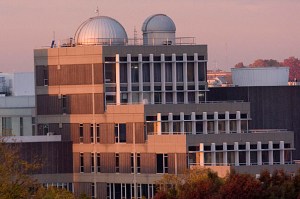
A snapshot of Harvard’s emission reductions
In 2007, Harvard University pledged to reduce its greenhouse gas (GHG) emissions, inclusive of growth, 30 percent by 2016, with 2006 as the baseline year. University-wide, GHG reductions are around 5 percent so far, including growth. The reductions are due to changes in Harvard’s energy supply and to activities and projects at Schools and units.
-
Science & Tech
‘Landscapes of Energy’
In a world marked by dams, oil fields, mines, and other energy infrastructure, scholars in a new Harvard journal begin looking at its social impact.
-
Campus & Community
Around the Schools: Graduate School of Design
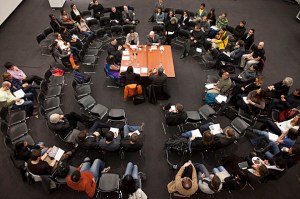
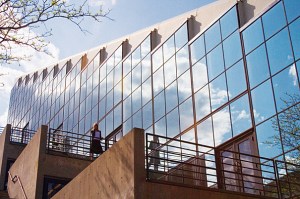
At the Graduate School of Design, there’s plenty of learning still going on inside classrooms. But, as in many other areas, the Web is also proving to be a gateway to novel ways of sharing ideas and building teamwork.
-
Arts & Culture
Practice, education, activism
The Graduate School of Design at Harvard celebrates one of its own, the late J. Max Bond Jr., a pioneering architect.

-
Campus & Community
Fundraising results signal continued strength
Despite a global economic downturn, Harvard University raised $602 million through fundraising efforts in fiscal year 2009.
-
Campus & Community
Building a happy ending
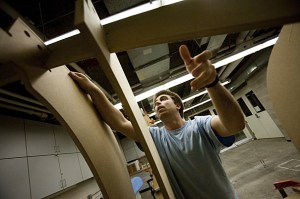
Harvard Graduate School of Design students unite to help Boston’s Chinatown neighborhood bring back a local library that was demolished 50 years ago to make way for Boston’s Central Artery.
-
Science & Tech
‘Bicycle Environments’ takes HSPH and GSD students for a ride
At a time when the United States scrambles to resolve the country’s obesity epidemic, reduce greenhouse gas emissions and air pollution, and lessen dependency on foreign fossil fuels, this semester the Harvard School of Public Health (HSPH) and the Graduate School of Design (GSD) have launched an interdisciplinary course that tackles all three problems (and…
-
Campus & Community
Paul Zofnass ’69, M.B.A. ’73 establishes GSD sustainability initiative
Paul Zofnass ’69, M.B.A. ’73 has established a sustainability initiative at the Harvard University Graduate School of Design (GSD) with a $500,000 gift.
-
Campus & Community
Harvard examining geospatial analysis technology programs
n Moshi, Tanzania, hard-hit by AIDS, researchers are using detailed aerial photographs and global positioning system receivers to locate study subjects in a maze of houses without addresses and streets without names. The project, a health program for children, families, and communities within Moshi by Harvard Medical School’s Children’s Health and Social Ecology (CHASE) program,…
-
Campus & Community
Barcelona works
A pioneer in his field, Richard forman has helped forge the basic concepts of landscape ecology, a science that sees the surface of the Earth as a complex mosaic linked by movements of people, animals, water, energy, nutrients, and other elements. It is a vision that goes well beyond urban planning in that, for example,…
-
Campus & Community
Designing solutions to fresh water shortage
Robert France, associate professor of landscape ecology at the Harvard Graduate School of Design, is a scientist who has studied the effect of environmental degradation of various plants and animals. Urban runoff is one of France’s areas of expertise. His knowledge gives him a very different view of the rainwater that flows down our sewers…
-
Science & Tech
Keys to the highway
Even though they have a massive effect on the natural world, roads have been pretty much ignored by ecologists, who prefer to focus on open areas – the territory between the roads. Nor have engineers and other specialists who design, build, and maintain roads been much concerned with the ecological effects of their creation. Richard…
-
Science & Tech
Where do you want your building?
Humans are changing location more frequently and in greater numbers than ever before in history. But at the same time, the electronic revolution is allowing them to remain in contact with one another to an extent undreamed of only a few decades ago. How does that development affect the concept of architecture? Jennifer Siegal has…
-
Science & Tech
Geographical information systems conference showcases the future
Begun as a mapping software decades ago, geographical information systems, known as GIS, today functions to manage different time- and place-dependent data and allows different variables to be projected together, making for decision support systems and for vivid, sometimes revealing comparisons. Brightly colored maps can show everything from traffic patterns to global warming to animal…
-
Science & Tech
The skin’s the thing for conserving a building’s energy
It has been estimated that a third of the world’s energy is consumed by buildings, a third by transportation, and a third by industry. With gasoline prices rising and electrical blackouts plaguing California and threatening the rest of the country, conserving energy in all areas seems more and more of a necessity. That’s why a…
-
Science & Tech
Street vendors often define urban landscape
“The question is, how is public space to be created — by designers, by the state, or by the people who use it?” asks Margaret Crawford, a professor at the Harvard Graduate School of Design. Crawford believes that “outlaw entrepreneurs” are helping to restructure and revitalize the city, not destroy it. Crawford has based much…