Thoreau in our time: Film, conversation, and a living legacy
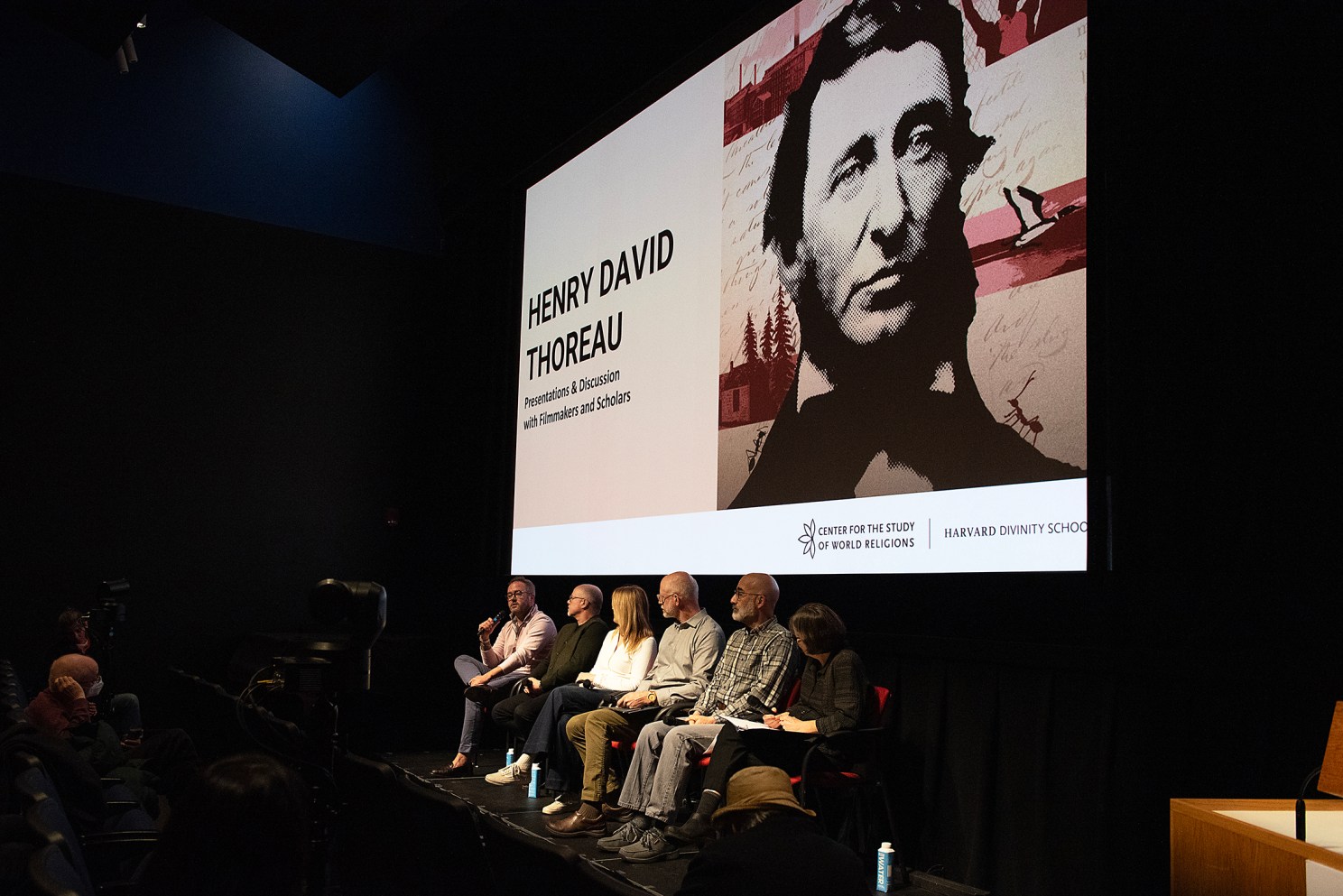
Christopher Loren Ewers, Erik Ewers, Susan Shumaker, Jeffrey S. Cramer, John J. Kucich, and Rebecca Kneale Gould answer questions following a screening of “Henry David Thoreau” at Harvard’s Carpenter Center for the Visual Arts.
More than 170 years after the publication of his groundbreaking book Walden and his essay “Civil Disobedience,” the eclectic writer, naturalist, activist, and philosopher Henry David Thoreau continues to resonate with new generations seeking direction amid societal division, political unrest, and an increasingly complex world.
Thoreau, widely regarded as the most recognizable face and voice of the 19th-century Transcendentalist movement, is the subject of a new three-part PBS documentary, “Henry David Thoreau,” executive produced by filmmaker Ken Burns and musician Don Henley. On April 3, the Center for the Study of World Religions (CSWR) hosted a screening of Episode 2 and a panel discussion at Harvard’s Carpenter Center for the Visual Arts, bringing together leading Thoreau scholars, directors Erik Ewers and Christopher Loren Ewers, and producer Susan Shumaker.
“The timing of this documentary’s release couldn’t be more fortuitous,” said Charles Stang, director of the Center for the Study of World Religions and professor of early Christian thought at Harvard Divinity School. “This year, the center has launched a new Transcendentalism initiative, grounded in the conviction that Transcendentalism is a living tradition whose rich history, diverse representatives, and contemporary exemplars offer today’s world enormous resources for reimagining how we might relate differently to ourselves, to one another, to our work, labor, and play, and to our words.”
The screening follows a collaborative two-day October workshop in Concord, Massachusetts, on the legacy and future of Transcendentalism, which served as the nexus for a new CSWR initiative. Nearly 30 scholars, practitioners, artists, and others from across the United States, Sweden, and Denmark gathered at the Concord Museum for panels, small-group discussions, and experiential activities in and around the town that gave birth to the Transcendentalist movement.
The CSWR plans to continue and expand those seed conversations this fall. More than 20 scholars, writers, artists, and practitioners will be in residence at the center in 2026–2027 to explore the history and future of the Transcendentalist movement and its relevance today.
“It is very much in the spirit of the Transcendentalists, who would at times live together for weeks or months, talking, walking, writing, and sharing,” said CSWR Executive Director Gosia Sklodowska.
On April 3, more than 150 people attended the screening, with over 400 more joining online. The event also included scholars Rebecca Kneale Gould, a religious studies scholar and associate professor of environmental studies at Middlebury College, John Kucich, Professor of English at Bridgewater State University, and co-President of the Thoreau Alliance, Jeffrey S. Cramer, editor of “Walden: A Fully Annotated Edition” and curator emeritus of the Walden Woods Project Library, as well as Jenifer Ishee, curator and library administrator of the Walden Woods Project.
For the Ewers brothers, telling Thoreau’s story became an opportunity to show a life far deeper than what is taught in a school classroom. The project evolved into an enriching exploration of both the historical figure and the legend surrounding him, culminating in three one-hour episodes that took five years to complete.
Creating the film also became a life-changing experience for the filmmakers, who recognized Thoreau’s prophetic insight, as described in Walden in the mid-1800s, about the nature of being swept up in status, surplus, and work — observations that still ring true in today’s culture nearly two centuries later.
“Thoreau and Ralph Waldo Emerson introduced [us] to Transcendentalism, not as a philosophy, but as a lived experience,” Erik said.
Thoreau was part of the Transcendentalist movement, a circle of New England Unitarian ministers, writers, philosophers, and intellectuals who devoted considerable thought and eloquence to the social problems and challenges of their time. Although they often disagreed with one another, they shared a commitment to self-reliance, intuition, and the importance of human connection with nature and with one another.
Shumaker said the focus on Transcendentalism couldn’t be happening at a more important moment in history.
“Many of us are struggling to make sense of the ideals that guide us — justice for all human beings; the health of our planet and the species it sustains; the quest for a meaningful life; the importance of standing up for our beliefs in the public square,” she said. “I think the project will have been phenomenally successful if it moves beyond the academy [and] into the world in a way that energizes people in all walks of life, helping each of us find a deeper connection to each other, to the planet, and to ourselves.”

 Featured series