
 Featured series
All articles
-
Campus & Community
Beyond the Biopsy: A Tiny Monitor for Cancer
Doctors doing a needle biopsy to analyze tissue for cancer may one day add a second step to the procedure: depositing a tiny device at the site to report on growth of a tumor — and even the effects of chemotherapy.
-
Campus & Community
Examining the roots of family tree
“The Human Family Tree,’’ airing tomorrow on National Geographic Channel, tells us when, where, and how humanity spread from Africa across the globe.
-
Campus & Community
Freud’s Adirondack Vacation
Sigmund Freud arrived in Hoboken, N.J., 100 years ago today on his first and only visit to the United States.
-
Campus & Community
Don’t amputate the wrong leg
Are you scheduled for surgery in 2010? If so, you should know that agreeing to an operation involves some risk. This is a fact of life, and there may never be a way to reduce the risk to zero. But a study from Harvard Medical School shows there’s a proven way to cut deaths following…
-
Campus & Community
Harvard to create Safety Advisory Committee and safety ombudsman function
Harvard University officials today (Aug. 28) announced plans to implement recommendations included in a recently issued report that examined Harvard University Police Department’s (HUPD) relations with the rest of the Harvard community. The report, which was released in April by a six-member committee appointed by Harvard President Drew Faust and led by former Suffolk County…
-
Campus & Community
‘Tweens’ feel pressure for perfect bodies
Ten- and 11-year-old boys and girls feel pressured to have perfect bodies, U.S. and Canadian researchers found. The researchers found a direct association between body satisfaction and weight in fifth graders — part of the age group increasingly known as tweens by those in media marketing…
-
Campus & Community
For Best Results, Take the Sting Out of Criticism
This may come as a surprise, but I don’t like criticism. I prefer constant praise and approval from my friends, family and bosses.
-
Health
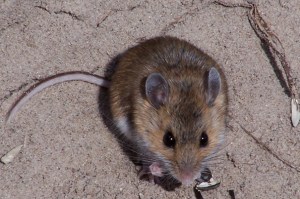
Mice living in Sandhills quickly evolved lighter coloration
A vivid illustration of natural selection at work: Harvard scientists have found that deer mice quickly evolved lighter coloration after glaciers deposited sand dunes atop what had been much darker soil.
-
Campus & Community
Andover’s Rousmaniere teaches soccer in Africa
For Andover’s Adam Rousmaniere, life simply has a different meaning now. “When I got home, everything seemed different,” he said. “It was difficult to readapt. You look at things here and you think, how can you get upset over that? How does that bother you? Readapting to life in the United States was quite an…
-
Campus & Community
Mouse set to be ‘evolution icon’
A tiny pale deer mouse living on a sand dune in Nebraska looks set to become an icon of biology. Within just a few thousand years, generations of the mice have evolved a sandy-coloured coat camouflaging themselves from predators…
-
Health
Neural response to electrical currents isn’t localized, as previously believed
For more than a century, scientists have been using electrical stimulation to explore and treat the human brain. The technique has helped identify regions responsible for specific neural functions and has been used to treat a variety of conditions from Parkinson’s disease to depression. Yet no one has been able to see what actually happens…
-
Health
Study finds promise in combined transplant/vaccine therapy for high-risk leukemia
Two of the most powerful approaches to cancer treatment — a stem cell transplant and an immune system-stimulating vaccine — appear to reinforce each other in patients with an aggressive, hard-to-control form of leukemia, Harvard scientists at Dana-Farber Cancer Institute (DFCI) have found. The researchers report that patients with high-risk acute myeloid leukemia (AML) or…
-
Health
Low-carb diets linked to atherosclerosis and impaired blood vessel growth
Even as low-carbohydrate/high-protein diets have proven successful at helping individuals rapidly lose weight, little is known about the diets’ long-term effects on vascular health. Now, a study led by team of Harvard researchers at Beth Israel Deaconess Medical Center (BIDMC) provides some of the first data on this subject, demonstrating that mice placed on a…
-
Campus & Community
Akpan named to Hermann Trophy Watch List
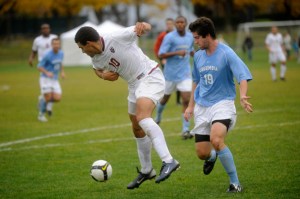
For the second consecutive season the National Soccer Coaches Association of America has named Andre Akpan ’10 to the Missouri Athletic Club’s Hermann Trophy Watch List.
-
Campus & Community
Preseason media poll votes Harvard Ivy favorite
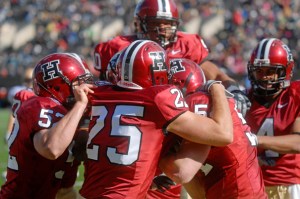
Expectations are high for No. 23-ranked Crimson football team, who were named the Ivy championship favorite at the league’s annual media day.
-
Health
Fragile period of childhood brain development could underlie epilepsy
A form of partial epilepsy associated with auditory and other sensory hallucinations has been linked to the disruption of brain development during early childhood, according to a study led by researchers at Beth Israel Deaconess Medical Center (BIDMC). Described in today’s advance online edition of Nature Medicine, these new findings provide the first genetic link…
-
Health
Prepping for H1N1, round 2
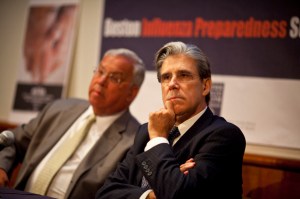
While questions still remain about the H1N1 flu’s potential virulence in the coming months, there is little doubt that this particular viral strain will return.
-
Campus & Community
University fine-tunes response plan for H1N1
University officials, building on lessons learned after a cluster of H1N1 cases was identified at the Dental School last spring, are fine-tuning plans to respond to any “swine flu” cases that appear on campus this fall.
-
Campus & Community
Katherine N. Lapp named Harvard executive vice president
Katherine N. Lapp, executive vice president for business operations for the University of California, will become Harvard University’s executive vice president, President Drew Faust announced today (Aug. 20). Lapp will assume her duties in early October.
-
Arts & Culture
Making music and keeping the faith
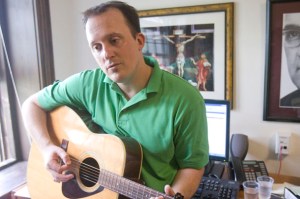
The father of two young children and an amateur musician, Matthew Myer Boulton, HDS associate professor of ministry studies, is investigating the spiritual dimension of human experience through the use of song with his newly formed band Butterflyfish.
-
Health
New metabolic safeguards against tumor cells revealed
Cells don’t like to be alone. In the early stages of tumor formation, a cell might be pushed out of its normal home environment due to excessive growth. But a cell normally responds to this homeless state by dismantling its nucleus, packing up its DNA, and offering itself to be eaten by immune system cells.…
-
Health
Study supports DNA repair-blocker research in cancer therapy
Scientists at Dana-Farber Cancer Institute have uncovered the mechanism behind a promising new approach to cancer treatment: damaging cancer cells’ DNA with potent drugs while simultaneously preventing the cells from repairing themselves. The findings, reported in the Aug. 14 edition of Molecular Cell, help explain the promising results being seen in clinical trials of compounds…
-
Campus & Community
Harvard Welcomes 20 Incoming Cross Country Runners
Director of track and field and cross country Jason Saretsky announced his incoming freshmen class for cross country Wednesday. The rookie class is made up of 12 men and eight women hailing from six states (California, Illinois, Massachusetts, Minnesota, New Jersey, and New York) and two countries (Canada and England).
-
Health
NIH renews Harvard Center for AIDS Research grant for another five years
The National Institutes of Health has renewed for five years – and $18.1 million – the funding for the Harvard University Center for AIDS Research (Harvard CFAR). Harvard is one of only 20 NIH CFAR sites in the U.S. and first received the designation in 2004. The award, under the umbrella of the Harvard Initiative…
-
Health
Researchers discover chemical that kills cancer stem cells
A multi-institutional team of Boston-area researchers has discovered a chemical that works in mice to kill the rare but aggressive cells within breast cancers that have the ability to seed new tumors. These cells, known as cancer stem cells, are thought to enable cancers to spread — and to reemerge after seemingly successful treatment. Although…
-
Health
Kauffman Foundation awards researcher entrepreneurial fellowship
Praveen Kumar Vemula, a postdoctoral researcher in the Karp Lab at Brigham and Women’s Hospital, is one of 13 researchers to receive the Kauffman Foundation Entrepreneurial Postdoctoral Fellowship Award. Vemula was selected in part for his entrepreneurial vision to take lab research to market and for his recent breakthrough research with Jeffrey Karp, instructor in…
-
Science & Tech
Research team at Harvard to develop small-scale mobile robotic devices
A multidisciplinary team of computer scientists, engineers, and biologists at Harvard received a $10 million National Science Foundation (NSF) Expeditions in Computing grant to fund the development of small-scale mobile robotic devices. Inspired by the biology of a bee and the insect’s hive behavior, the researchers aim to push advances in miniature robotics and the design of compact…
-
Health
Postdiagnosis aspirin use reduces risk of dying from colorectal cancer
Regular use of aspirin after colorectal cancer diagnosis may reduce the risk of cancer death, report Harvard researchers at Massachusetts General Hospital (MGH), Dana-Farber Cancer Institute (DFCI) and Brigham and Women’s Hospital. In today’s edition of the Journal of the American Medical Association, the study’s authors also find that the aspirin-associated survival advantage was seen…
-
Science & Tech
After bloody revolution: Bringing science back to Liberian classrooms
Adam Cohen and Ben Rapoport needed materials to conduct a science experiment, but supplies were hard to come by. Cohen, assistant professor of chemistry and chemical biology and of physics in the Harvard Faculty of Arts and Sciences, and Rapoport, an M.D./Ph.D. student at Harvard Medical School and the Department of Electrical Engineering and Computer…
-
Science & Tech
Chu urges U.S. to anticipate its energy future
U.S. Energy Secretary Steven Chu described the U.S. failure to anticipate changes in the global energy supply during a talk at the John F. Kennedy School of Government Aug. 6. Chu cited the discovery of lithium batteries as just one of the many advanced technologies that the United States has surrendered over the decades to…